AI platform For companies in pharmaceuticals, agrochemicals, and veterinary medicine that use patent data to find new development directions

Request access

Generative Module

Generates potentially active drug-like molecular structures de novo based on compounds disclosed in patents and specialized databases. Generated structures are automatically checked for patent purity.

  • De novo Design
  • Target Binding
  • Patent-clean

Markush Structure Analysis

Checks compounds against Markush structures and patent claims. Based on the analysis results, IPLN provides a reasoned verdict for each claim and the corresponding fragment of the molecule.

  • Mapper
  • Fitter
  • Similarity

Peptide Generation

Generates potentially active peptide sequences de novo and optimizes specified properties. Each candidate is automatically checked by the Markush structure analysis module for overlap with patent claims, allowing selection of only patentable options.

  • De novo Design
  • Target Binding
  • Patent-clean

Target Patent Search

Finds and organizes patents related to a given target, including indications, expression profile, and development status of competing programs. Replaces weeks of manual patent landscape monitoring with a structured selection in minutes — fully covering patent numbers, publication dates, rights holders, and citations.

  • Indication
  • Status

Structure Search

Searches patents and compounds by chemical structure, similarity, or substructure, with automatic checks for duplicates and inconsistencies across hundreds of thousands of extracted entities. Shows instantly whether a structure is already protected by an existing patent, before synthesis even begins.

  • OCSR
  • Substructure
  • IUPAC

Binding Site Similarity Analysis

Uses 3D-to-1D fingerprints to quickly find binding sites with similar geometry and properties across targets. Helps repurpose existing compounds and assess the risk of side effects in advance.

  • Binding Site
  • Sequence Compounds
Request access
95%+Data extraction accuracy
~0.5hAverage patent processing time
MinutesMarkush structure matching for thousands of structures
<1 minMatching 1 structure against invention claims
70+Languages

Generative Module

Request access
1 / 5
Screen 1: Generative Module
Screen 2: Markush Structure Analysis
Screen 3: Peptide Generation
Screen 4: Target Patent Search
Screen 5: Binding Site Similarity Analysis

One platform — the entire journey from idea to molecule and patent.

Choose an object to analyze, such as a target, a compound structure, or competitor patent numbers. IPLN will do everything else for you automatically! The platform extracts chemical structures, biological test results, patent information, and other key data from thousands of pages of documents with high accuracy.

What used to require weeks of manual work by a patent analyst now takes minutes. Every molecule is checked against Markush structures and patent claims. IPLN provides a well-founded verdict on each claim, including cases where classic tools such as SciFinder find no answer at all. The generative module creates new drug-like structures and peptide sequences by applying medicinal chemistry rules and cheminformatics algorithms. IPLN checks the generated candidates for patent purity.

The result is not a hypothesis, but a candidate with a clean IP profile.
Full R&D cycle based on IPLN

Entry point — any of the three:

  • Biological target
  • Molecular structure
  • Patent numbers

No matter where you start, the platform guides you through the same cycle to the same result.

Data extraction and analysis

IPLN collects and organizes everything related to the chosen entry point, including chemical compounds, pharmacological data, literature, and patents on the target, regardless of whether they are scattered across dozens of sources and what language they are written in.

Patent coverage analysis

Extracted and specified structures are checked against Markush structures and patent claims. The binding site similarity analysis module compares their geometry and properties across related targets. As a result, you get a clear picture of what is already protected and what remains free.

Generation and verification of patent purity

The generative module creates drug-like small molecule and peptide structures. Each generated candidate is checked for overlap with patent claims.

Result

The outcome is not a hypothesis but a patentable candidate with a justified verdict on each fragment, ready for synthesis and, if biological testing is successful, a patent application.

Regardless of the entry point, the result is the same — a candidate with a clean patent profile, ready to form the basis of your own IP.

From patent landscape to your own IP in 24 hours

Case Study · AI-Driven Drug Discovery

Target: MALT1

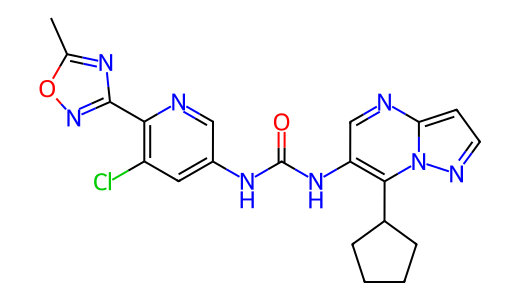
MALT1 (paracaspase) is the central protease of the CARD11–BCL10–MALT1 (CBM) signalosome that drives NF-κB activation in B-cell lymphomas — a validated but historically hard-to-drug target, addressed here by targeted protein degradation (PROTAC). Reference warhead: a pyrazolo[1,5-a]pyrimidine MALT1 binder.

MALT1-binding warhead (reference)
MALT1 warhead · reference

Patent Landscape & Off-Target Analysis

50 patents on MALT1 inhibitors and degraders processed and 3,000+ chemical structures extracted — in 3 hours. In parallel, a binding-site similarity module (3D-to-1D fingerprints) mapped the MALT1 pocket and the CRBN E3-ligand against the binding sites of related paracaspases and E3 ligases, flagging potential off-targets and fixing selectivity requirements before design began.

Generative Design

From the extracted corpus plus external databases, the generative module proposed 1,500 novel bivalent structures (warhead–linker–E3-ligand) in 1 hour, applying medicinal-chemistry rules, 3D shape-similarity scoring and MCF filters.

Automated Patentability Check of Generated Structures

Every candidate was screened against Markush structures and claim language in the selected patents. In 30 minutes a patent-clear candidate was selected — a result equivalent to an expert's manual review, reached in hours rather than weeks.

Result

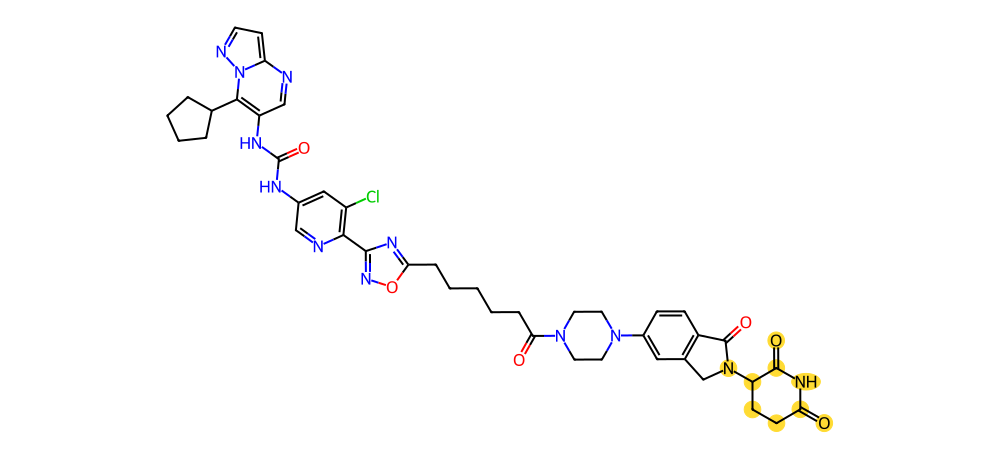
A new series of MALT1 PROTAC degraders was obtained and entered patent WO2023164175A2. Lead Example 3 drives near-complete MALT1 degradation in Jeko-1 mantle-cell-lymphoma cells — MALT1 reduced to ~10% of control at 1 µM (24 h / 48 h, FIG. 2) — with selectivity over related paracaspases.

Bottom line

24 Hours, Not Months

A full R&D cycle — from patent analysis to a patentable compound with confirmed activity — completed in 24 hours instead of months of multidisciplinary teamwork. The resulting MALT1 degrader is disclosed as Example 3 of WO2023164175A2.

Example 3 MALT1 PROTAC degrader, WO2023164175A2
  • MALT1 ligand
  • linker
  • CRBN ligand (glutarimide)
Example 3 · C₄₂H₄₅ClN₁₂O₆ · MW 849 · MALT1 → ~10% at 1 µM (Jeko-1)
WO 2023 164 175 A2
Request access